Warning! Beware of scammers and fraud. There are companies illegally using our name! Read more about their methods here.

Google rating 4.9 out of 5
Rating 4.9 out of 5

Need to replace your main sewer line?
We only stop when your sewer flows freely again.

Our own staff
Prior camera inspection
Transparent pricing

Call us at 085 303 9999

Schedule an appointment now

Fixed price
No call-out fees
3-month warranty

Replace main sewer line

Sometimes, unclogging or cleaning is no longer enough, and the main sewer line needs to be replaced. That sounds like a big job, and it is. But with the right approach and an experienced team, it doesn't have to take long, and you'll know exactly what to expect beforehand.

The main sewer line is the central drain pipe of your home; it's the pipe that carries all wastewater from your house to the municipal sewer system. For severe damage, repeated blockages, or very old pipes, replacement is the best and most lasting solution.

Call us for a free consultation or schedule an inspection directly.

When should the main sewer line be replaced?

Not every sewer blockage means your entire main sewer line needs to be replaced. However, there are situations where replacement is the only lasting solution. A camera inspection will map out the condition of your pipe and show if replacement is necessary.

Replacement is necessary if:

The pipe is severely damaged

With multiple breaks, large cracks, or collapsed sections, repair is no longer possible or cost-effective.

The sewer repeatedly gets clogged

If you have to have your main sewer line unclogged every year, there is often a structural problem that can only be solved by replacement.

The pipe has significantly sagged

A sag creates a low point where debris can build up. While minor sags can sometimes be repaired, significant sagging over several meters often requires a full replacement.

The material is severely aged

Clay, cast iron, and concrete sewer pipes that are older than 40 to 60 years have often reached the end of their useful life.

Root growth repeatedly returns

If tree roots repeatedly penetrate the sewer system through joints or cracks, only a full replacement will permanently solve the issue.

Signs that your main sewer line needs replacement

You don't need to be a plumbing expert to notice when there's a problem with your main sewer line. Look out for these warning signs:

Recurring Clogs

Has your main sewer line been clogged multiple times in the past year, even after professional cleaning? If so, there's a good chance the problem is structural, such as a sag, cracks, or worn-out material.

Sewer Odor Inside and Around Your Home

A persistent sewer smell in your crawl space, garden, or home could indicate leaks in the main sewer line. Sewer gas can escape through cracks or loose connections. Our technicians can pinpoint the exact location of the leak using smoke detection.

Damp Spots in the Garden

Noticeably green or wet patches in your garden above the sewer line can indicate a leaking main sewer. The escaping wastewater contains nutrients that promote extra grass growth.

Sinking Pavement or Garden Areas

If the ground above your sewer line sinks, it could mean the pipe is broken and soil is washing away. This is a serious warning sign that requires quick action to prevent further damage to your home.

Pests: Sewer Flies or Rats

A damaged sewer can attract pests.  Sewer flies breed in stagnant wastewater, and rats use cracks in the pipes as an entry point. If you're experiencing pest issues along with sewer problems, it's advisable to have your main sewer line inspected.

Why Choose Replacement Over Relining?

You might have heard of relining, a technique where a plastic liner is inserted into an existing pipe. This sounds appealing because it avoids digging. However, at RBNL, we deliberately opt for a complete replacement. Here's why:

A Completely New Sewer System

With a full replacement, you receive a completely new SN4 PVC pipe. This means a brand-new system, not just a liner inside an old, damaged pipe, ensuring it will last for 50+ years.

Sagging Remains Sagging

For a sagged sewer, relining doesn't solve the core issue. The pipe will remain at the same low point, allowing debris to accumulate and eventually leading to recurring blockages. Only a complete replacement ensures the pipe is laid with the correct slope.

Cast Iron Never Becomes Smooth Again

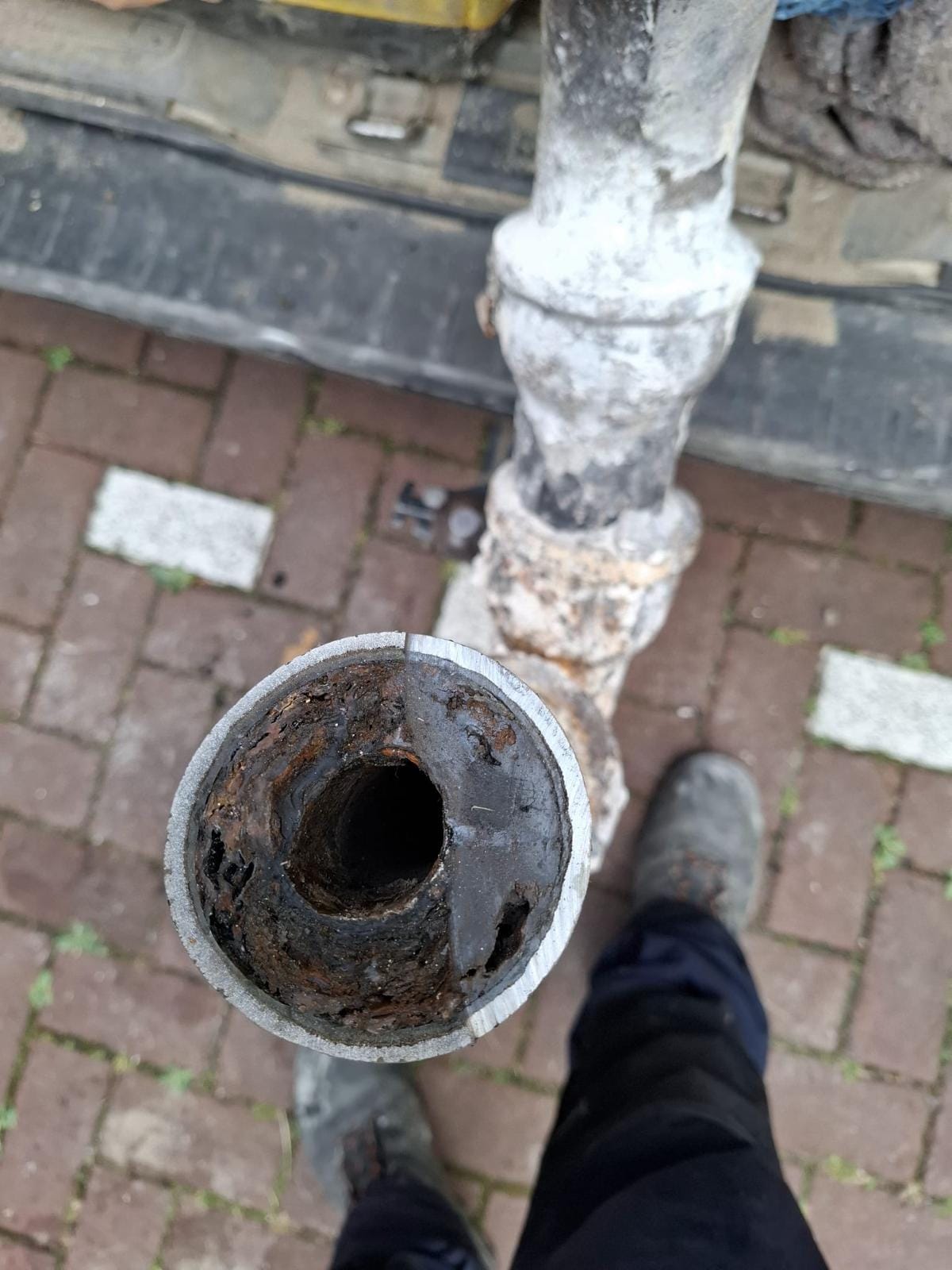
Old cast iron pipes become severely corroded and rough on the inside over years. Inserting a liner means you're keeping the existing narrowing. With a replacement, you get a smooth PVC pipe with its full diameter, allowing water to flow optimally again.

Inspection and Cleanout Point

When we perform a full replacement, we install an inspection and cleanout point, making the sewer system easy to check and maintain in the future. This is not always possible with relining.

Clarity about the condition of your sewer system

After replacement, you can be sure that your entire main sewer line is new. With relining, the old pipe remains in place, along with any hidden defects.

Replace the main pipe
Old cast iron sewer pipe removed by RBNL. The diameter is largely blocked due to corrosion. Relining does not solve this problem.

How does RBNL replace your main sewer line?

Replacing a main sewer line is a job that requires careful attention. Our technicians work step-by-step and keep you informed of the progress at every stage.

Step 1: Camera Inspection

Everything starts with a thorough camera inspection. We map out the complete condition of the main sewer line: where the pipes run, what material they are made of, where the problems are located, and how serious they are. Based on this inspection, we draw up a plan.

Step 2: Quote and Planning

You will receive a detailed quote with a clear description of the work, the costs, and the schedule. No surprises afterward. We only start the work after your approval.

Step 3: Preparation and Excavation

The work area is secured, and the existing main sewer line is exposed. For pipes in the crawl space (a common situation), we dig under the foundation to reach the main line. For outdoor sewer systems, the trench is dug in the garden or under the paving. Our technicians work as neatly as possible to limit damage to your home and garden.

Step 4: Removing the Old Pipe and Installing the New Pipe

The damaged pipe (often stoneware, concrete, or old PVC) is removed and replaced with a new main pipe made of SN4 PVC (110/125mm). This is the standard material for modern sewer systems: lightweight, strong, smooth on the inside (which prevents dirt from sticking easily), and with a lifespan of over 50 years. SN4 indicates the stiffness class and is suitable for sewer systems under and around homes.

Step 5: Connection and Finishing

All existing branches (from the kitchen, bathroom, toilet, and other drains) are connected to the new main line. Where possible, we also install an inspection and unblocking point, so the sewer system can be easily checked and cleaned in the future. The pipe is secured with brackets to keep it firmly in place.

Step 6: Control Inspection

After installation, we perform a camera inspection as a quality check. We test the flow and verify that all connections have been made correctly. Only when everything is in order do we conclude the work.

Step 7: Restoration Work

The trench is refilled, and the paving or garden is restored to its original condition as much as possible. Depending on the situation, it may be necessary to arrange separate garden restoration or paving work.

Our customers rate us with an average of 4.9/5

Read the most recent customer reviews below.

Main Sewer Replacement Costs

The costs for replacing a main sewer line depend on several factors: the length of the section to be replaced, the accessibility of the pipe, the material that needs to be removed, and the condition of the subsoil.

We determine the exact costs after the camera inspection. You will always receive a no-obligation quote before we start the work. This way, you know exactly what you will pay upfront.

What is always included with RBNL?

Camera inspection before and after the work
SN4 PVC pipe (110/125mm), the current standard material
Connection of all existing branches to the new pipe
Installation of an inspection and unblocking point (where possible)
Bracing and securing of the pipe
Warranty on materials and labor
No call-out fees
Clear quote upfront, no hourly rate

Who pays for the main sewer replacement?

This is a frequently asked question, and the answer depends on your living situation:

Homeowner

As an owner, you are responsible for all sewer lines on your property, including the main sewer line. Therefore, the costs for replacement are your responsibility. Some municipalities offer subsidies or loans for sewer replacement. Inquire with your municipality about the possibilities.

Tenant

The main sewer is considered "major maintenance" and is therefore the responsibility of the landlord, housing corporation, or homeowners' association (VvE). As a tenant, you are not responsible for the replacement costs, but you are required to report any issues to your landlord.

Homeowners' Associations (VvE) and Property Managers

For Homeowners' Associations (VvE) and property managers , it is wise to create a multi-year maintenance plan that includes the sewage system. Preventive maintenance (such as periodic cleaning of the main sewer) and timely replacement help avoid expensive emergency repairs and water damage.

Does your insurance cover the replacement of the main sewer?

That depends on your policy conditions and the cause of the damage. A damaged main sewer due to a sudden event (like subsidence or construction damage) may sometimes be covered by your building insurance. However, wear and tear from aging is usually not covered, as it's considered "deferred maintenance."

Our advice: contact your insurer in advance to ask if the work will be covered. We always provide an invoice and an inspection report with camera footage afterwards, which you can submit to your insurance company. Many of our customers receive reimbursement for some or all of the costs.

Is your main sewer due for replacement? Get free, no-obligation advice.

Lifespan of Sewer Materials

The material of your main sewer largely determines when it needs to be replaced. Here's an overview of the most common materials and their expected lifespan:

MaterialCommon in homes built fromExpected lifespan
Clay (fired clay)Before 197050 to 80 years
Concrete1950 to 198040 to 60 years
Cast iron1920 to 197040 to 70 years
PVC (SN4, 110/125mm)From 1970 (current standard)50+ years

Do you live in a home built before 1980 and has the sewer never been replaced? Then it's wise to have a sewer inspection performed to assess the condition of your main sewer.

Common scenario: replacing clay with PVC

Most of the main sewers we replace are old clay pipes found in crawl spaces. Clay (fired clay) was commonly used in homes built before 1970. After 50 to 80 years, the joints often wear out, allowing roots and soil to enter the sewer. For these jobs, we remove the old clay pipe and install a new main pipe made of SN4 PVC (110/125mm), which includes connecting all branch lines and adding an inspection and unblocking point. These types of replacements are typically completed within one working day.

RBNL carefree

Discover Our Unconditional Service

Your home or work comfort is our priority!

Replacing your main sewer line is a significant undertaking. You want it done right the first time, by a company you can trust. RBNL is rated 4.9 on Google and 9.6 on Trustoo by customers.

Our own technicians, no subcontractors. 
Our certified professionals carry out all work themselves.

Transparent quote upfront. 
You know exactly what the costs are before we start. No surprises afterwards.

Camera inspection before and after. 
We document the condition of your sewer so you can see what has been done and why.

Warranty on materials and labor. 
You receive a warranty on all work performed.

Everything under one roof. 
From inspection and advice to replacement and repair work: we manage the entire process.

Active throughout the Randstad region.
Our technicians work daily in AmsterdamRotterdamUtrecht and the surrounding areas.

Frequently Asked Questions about Main Sewer Replacement

How long does it take to replace a main sewer line?

A standard replacement in the crawl space or outdoor sewer system usually takes 1 working day. For longer routes or complex situations (for example, under an extension or with multiple branches), it can take 2 to 3 days. You will receive a time estimate with the quote beforehand. We do not charge hourly rates.

Can I stay home during the work?

Yes, in most cases. During the replacement, the sewer system will be temporarily out of use. Our technicians will provide a temporary solution where possible so that you can at least use the toilet. We will discuss this with you beforehand.

Do I need to apply for a permit to replace the sewer?

For work on private property, a permit is usually not required. If excavation is required in public areas (for example, for connection to the municipal sewer), a permit or notification to the municipality may be necessary. We will take care of this for you as part of the process, if needed.

Why doesn't RBNL perform relining?

Relining involves inserting a plastic liner into the existing pipe. While this sounds less invasive, in practice, the main sewer line is often too damaged for relining (due to sagging, multiple breaks, or too small a diameter). We opt for full replacement because it provides you with a completely new SN4 PVC sewer system that will last 50+ years, including an inspection and unblocking point. No compromises, no hidden defects.

How do I know if my sewer is made of asbestos?

Asbestos cement sewer pipes were commonly used in homes built between 1950 and 1985. Our technicians can identify the material during a camera inspection. If asbestos is present, the work will be carried out according to the applicable safety guidelines.

Does RBNL offer a warranty on the new sewer system?

Yes, you receive a warranty on both the materials and the work performed. The exact warranty conditions will be included in the quote. PVC pipes have an expected lifespan of over 50 years.