Beware! Beware of scammers and fraud. There are companies using our name unlawfully! Read more about their methods here.

Our sewer services
Our sewer services
Beware! Beware of scammers and fraud. There are companies using our name unlawfully! Read more about their methods here.
Our sewer services
Our sewer services
✓ Use of our own staff
✓ Preliminary camera inspection
✓ Transparent quote
Call us at 085 303 9999
✓ Fixed price
✓ No call-out charges
✓ 3-month warranty

Sometimes unclogging or cleaning isn’t enough, and the main sewer line needs to be replaced. That sounds like a major undertaking—and it is. But with the right approach and an experienced team, the job doesn’t have to take long, and you’ll know exactly what to expect from the start.
The main sewer line is the central drainage pipe in your home: the pipe that carries all the wastewater from your house to the municipal sewer system. In cases of severe damage, repeated blockages, or severely aged pipes, replacement is the best and most sustainable solution.
Call us for a no-obligation consultation or schedule an inspection right away.
Go directly to:
Not every sewer blockage means your entire main sewer line needs to be replaced. However, there are situations where replacement is the only long-term solution. Acamera inspectionassesses the condition of your pipe and determines whether replacement is necessary.
Replacement is necessary if:
If there are multiple breaks, large cracks, or missing pieces, repair is no longer possible or cost-effective.
If you have to have yourmain sewer lineunclogged every year, there is often an underlying problem that can only be resolved by replacing the pipe.
A sinkhole creates a low spot where debris accumulates. Minor sinkholes can sometimes be repaired, but if the sinkhole is severe and spans several meters, replacement is the best option.
Stoneware, cast iron, and concrete sewer pipes that are more than 40 to 60 years old are often nearing the end of their service life.
If tree roots keep growing into the sewer through joints or cracks, the only way to permanently solve the problem is to replace the pipe.
You don't have to be a plumbing expert to tell that something is wrong with your main sewer line. Watch out for these warning signs:
Has the main sewer line become clogged multiple times over the past year, despite professional cleaning? If so, there’s a good chance the problem is structural: a sag, cracks, or worn-out material.
A persistent sewer odor in your crawl space, yard, or home may indicate leaks in the main sewer line. Sewer gas escapes through cracks or loose connections. Usingsmoke detection, our technicians can pinpoint the exact location of the leak.
Noticeably green or wet patches in the garden above the sewer line may indicate a leaking main sewer. The leaking sewage contains nutrients that cause the grass to grow more vigorously.
If the ground above the sewer line sinks, it could mean that the pipe has broken and soil is being washed away. This is a serious warning sign that requires immediate action to prevent further damage to your home.
A broken sewer line can attract pests.Drain fliesbreed in stagnant sewer water, and rats use cracks in the pipes as entry points. Are you dealing with pests along with sewer problems? If so, have the main sewer line inspected.
You may have heard of pipe relining: a technique that involves inserting a plastic liner into the existing pipe. It sounds appealing because it doesn’t require any digging. But at RBNL, we deliberately opt for complete replacement. Here’s why:
When we replace the pipe, you’ll get a brand-new SN4 PVC pipe. Not a liner inserted into an old, damaged pipe, but a completely new system that will last another 50+ years.
If a sewer pipe has sagged, relining won’t solve the underlying problem. The pipe will continue to sag at the same spot, causing debris to accumulate there and leading to blockages again over time. Only a complete replacement will ensure the pipe is installed with the proper slope.
Old cast-iron pipes have become severely corroded and rough on the inside due to years of corrosion. Installing a liner inside them means you retain the reduced diameter. Replacing them gives you a smooth PVC pipe with its full cross-sectional area, allowing water to flow through optimally again.
When performing a complete replacement, we install an inspection and access point so that the sewer can be easily inspected and maintained in the future. This is not always possible with relining.
After replacement, you can be sure that your entire main sewer line is brand new. With relining, the old pipe remains in place, along with any hidden defects.
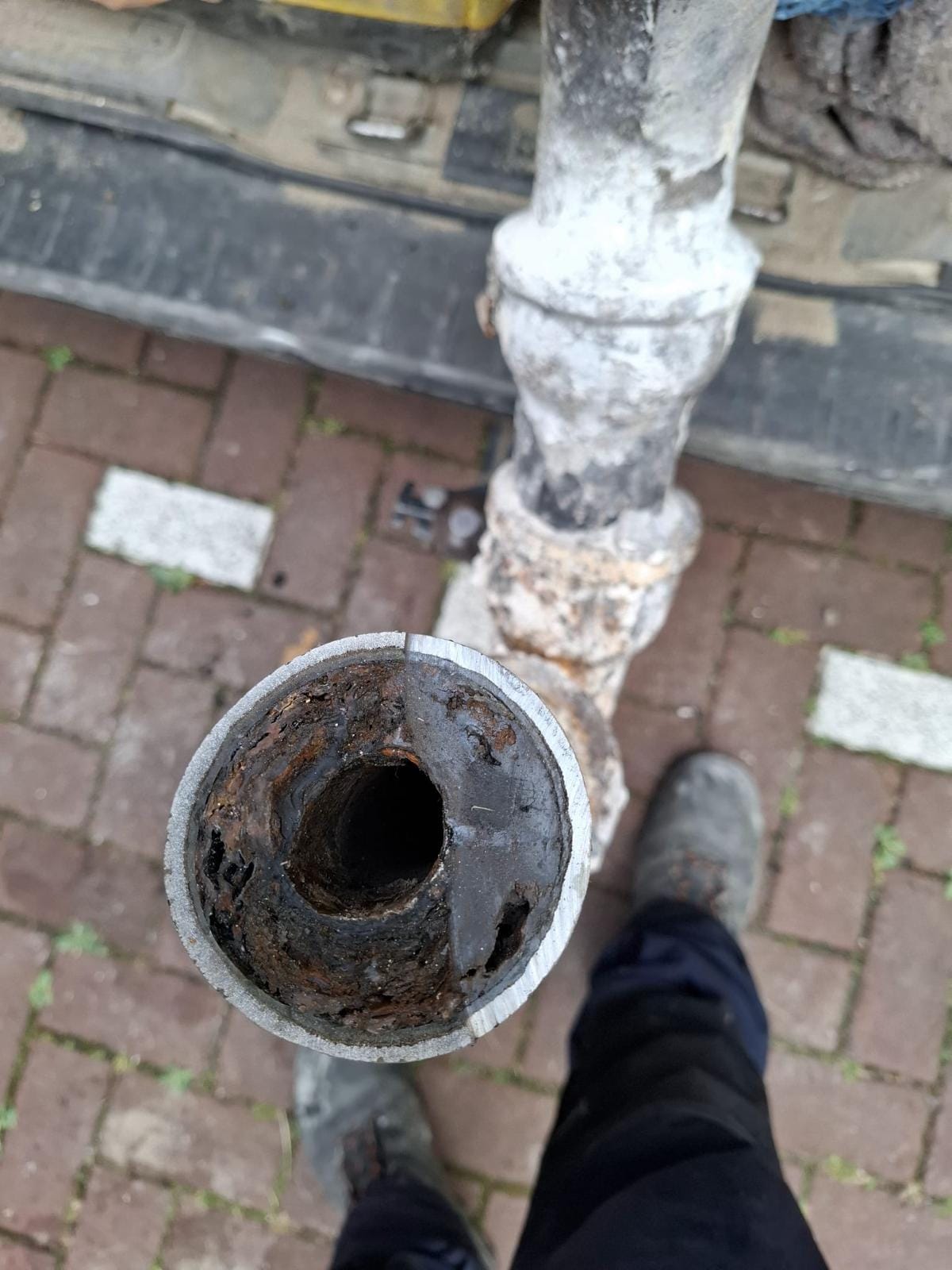
Replacing a main sewer line is a job that requires careful attention to detail. Our technicians work step by step and keep you informed of the progress at every stage.
It all starts with a thoroughcamera inspection. We assess the overall condition of the main sewer: where the pipes run, what materials they’re made of, where the problems are, and how serious they are. Based on this inspection, we draw up a plan.
You will receive a detailed quote with a clear description of the work, the costs, and the schedule. No surprises later on. We will not begin the work until you have given your approval.
The work area is secured and the existing main sewer line is exposed. If pipes are located in the crawl space (a common situation), we dig under the foundation to access the main line. For outdoor sewer lines, the trench is dug in the yard or under the pavement. Our technicians work as carefully as possible to minimize damage to your home and yard.
The damaged pipe (often clay, concrete, or old PVC) is removed and replaced with a new main pipe made of SN4 PVC (110/125 mm). This is the standard material for modern sewer systems: lightweight, strong, smooth on the inside (which prevents debris from sticking), and with a lifespan of over 50 years. SN4 indicates the stiffness class and is suitable for sewer systems under and around homes.
All existing branch pipes (from the kitchen, bathroom, toilet, and other drains) will be connected to the new main line. Where possible, we will also install an inspection and cleaning access point so that the sewer can be easily inspected and cleaned in the future. The pipe will be secured with clamps to ensure it remains firmly in place.
After installation, we conduct a camera inspection as part of our quality control process. We test the flow and verify that all connections have been made correctly. We only consider the work complete once everything is in order.
The trench will be filled in, and the pavement or garden will be restored to its original condition as much as possible. Depending on the situation, it may be necessary to arrange for separate garden restoration or paving work.
The cost of replacing a main sewer line depends on several factors: the length of the section to be replaced, the accessibility of the pipe, the material that needs to be removed, and the condition of the ground.
We determine the exact cost after conducting a camera inspection. You will always receive a no-obligation quote before we begin work. This way, you know exactly what you’ll be paying in advance.
✓ Camera inspection before and after the work
✓ SN4 PVC pipe (110/125 mm), the current standard material
✓ Connection of all existing branches to the new pipe
✓ Installation of an inspection and cleaning point (where possible)
✓ Bracing and securing the pipe
✓ Warranty on materials and labor
✓ No service call fee
✓ Clear quote upfront, no hourly rate
This is a frequently asked question, and the answer depends on your living situation:
As the property owner, you are responsible for all sewer lines on your property, including the main sewer line. This means you are responsible for the costs of replacement. Some municipalities offer grants or loans for sewer replacement. Check with your local municipality to find out what options are available.
The main sewer falls under “major maintenance” and is therefore the responsibility of the landlord, housing association, or homeowners’ association. As a tenant, you do not pay for the replacement yourself, but you are required to report any issues to your landlord.
Forhomeowners' associations and property managers, it is advisable to develop a long-term maintenance plan that also covers the sewer system. Preventive maintenance (such as periodiccleaning of the main sewer) and timely replacement help avoid costly emergency repairs and water damage.
That depends on your policy terms and the cause of the damage. A broken main sewer line caused by a sudden event (such as ground subsidence or construction damage) may be covered by your home insurance in some cases. Wear and tear due to age is usually not covered, as this is considered “neglected maintenance.”
Our advice: Contact your insurance provider in advance to ask whether the work will be covered. After the job is done, we always provide an invoice and an inspection report with camera footage so you can submit it to your insurance company. Many of our customers receive reimbursement for (part of) the costs.
Is your main sewer in need of replacement? Get a free consultation.
The material of your main sewer pipe largely determines when it needs to be replaced. Here is an overview of the most common materials and their expected lifespan:
| Materials | Commonly found in homes of | Expected lifespan |
|---|---|---|
| Stoneware (fired clay) | Before 1970 | 50 to 80 years old |
| Concrete | 1950 to 1980 | 40 to 60 years old |
| Cast Iron | 1920 to 1970 | 40 to 70 years old |
| PVC (SN4, 110/125 mm) | Since 1970 (current standard) | 50+ years |
Do you live in a home built before 1980, and has the sewer line never been replaced? If so, it’s a good idea to have a sewer inspection performed to assess the condition of your main sewer line.
Most of the main sewer lines we replace are old vitrified clay pipes located in crawl spaces. Vitrified clay (fired clay) was commonly used in homes built before 1970. After 50 to 80 years, the joints are often worn out, allowing roots and soil to penetrate the sewer line. For these jobs, we remove the stoneware pipe and install a new main line made of SN4 PVC (110/125 mm), including connecting all branch lines and installing an inspection and cleaning access point. These types of replacements are usually completed within one business day.

Your living or working comfort is our priority!
Replacing the main sewer line is a major undertaking. You want it done right the first time, by a company you can trust. RBNL has been rated 4.9 by customers on Google and 9.6 on Trustoo.
✓ In-house technicians, no subcontractors.
Our certified professionals perform all work themselves.
✓ Transparent quote upfront.
You’ll know exactly what the costs are before we get started. No surprises later on.
✓ Before-and-aftercamera inspection .
We document the condition of your sewer so you can see what was done and why.
✓ Warranty on parts and labor.
You receive a warranty covering all work performed.
✓ Everything under one roof.
From inspection and consultation to replacement and repairs: we handle the entire process.
✓ Serving the entire Randstad region.
Our technicians work daily in Amsterdam,Rotterdam,Utrecht, and the surrounding areas.
A standard replacement in the crawl space or outdoor sewer system usually takes one business day. For longer runs or more complex situations (such as under an addition or where there are multiple branches), it may take two to three days. You will receive an estimated timeframe in advance with your quote. We do not charge by the hour.
Yes, in most cases. During the replacement, the sewer line will be temporarily out of service. Whenever possible, our technicians will provide a temporary solution so that you can at least use the toilet. We will coordinate this with you in advance.
A permit is usually not required for work on your own property. If excavation is required in a public area (for example, when connecting to the municipal sewer system), a permit or notification to the municipality may be required. We will handle this for you as part of the process, if necessary.
Relining involves installing a plastic liner inside the existing pipe. That may sound less invasive, but in practice, the main sewer is often too damaged for relining (sagging, multiple breaks, too small a diameter). We opt for complete replacement because this gives you a brand-new sewer made of SN4 PVC that will last another 50+ years, including an inspection and access point. No compromises, no hidden defects.
Asbestos-cement sewer pipes were widely used in homes built between the 1950s and 1985. During a camera inspection, our technicians can identify the material. If asbestos is present, the work will be carried out in accordance with current safety guidelines.
Yes, you receive a warranty on both the materials and the work. We will include the exact warranty terms in the quote. PVC pipes have an expected lifespan of more than 50 years.

Rioolbeheer Nederland is the specialist for unblocking, cleaning, inspecting and locating sewers, drains and pipes. Your happiness is our goal. Customer satisfaction is our top priority.



Branches
Contact
Tel: 085 303 9999
Address:
Address Amsterdam:
Jacob van Lennepkade 151 H
1054 ZL Amsterdam
Address Utrecht Bilthoven:
PC Staalweg 60
3721 TJ Bilthoven
Email address: info@rbnl.nl
CHAMBER OF COMMERCE: 87133989
Copyright © 2026 – RBNL. All rights reserved.